Those Devils in Baggy Pants

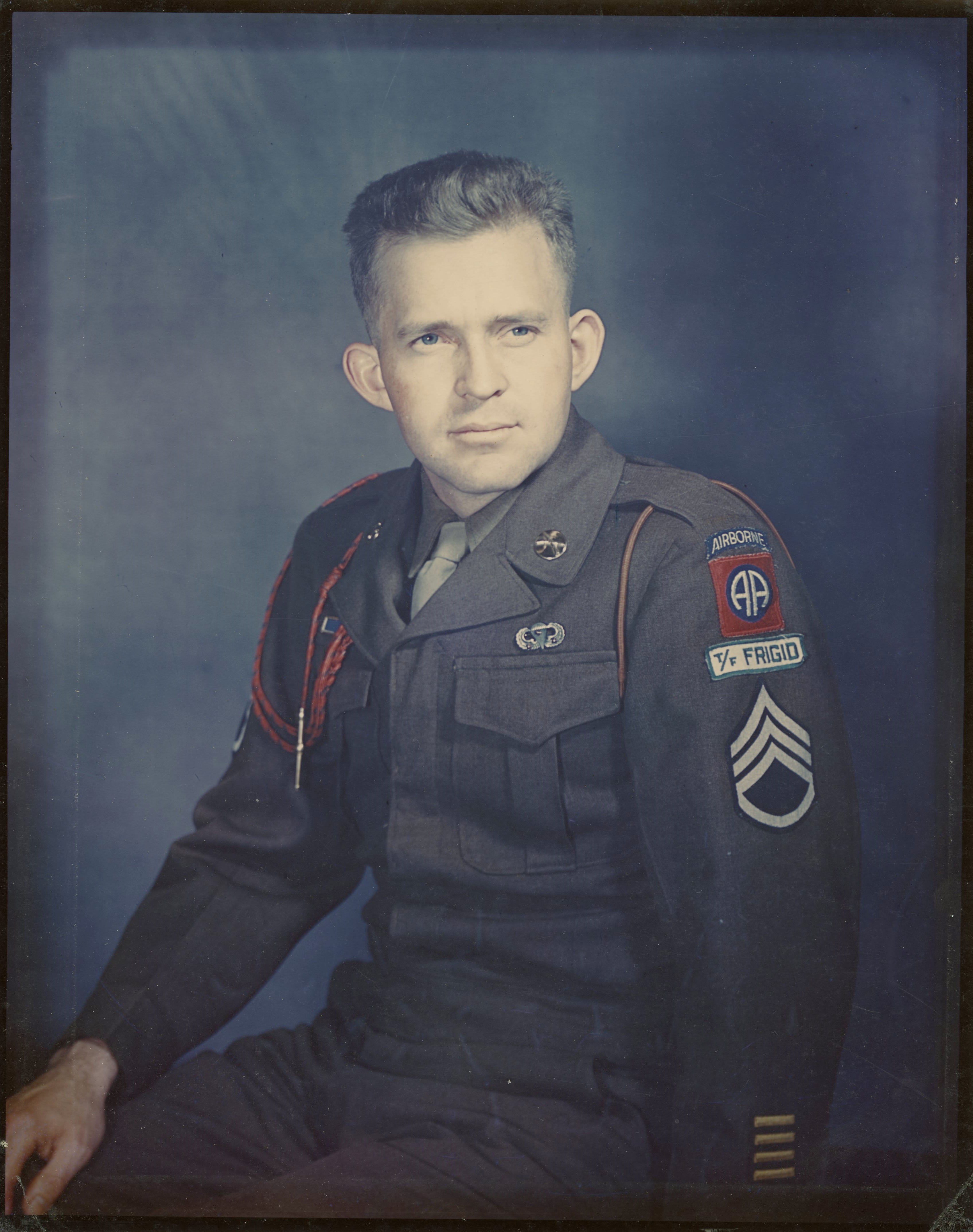
A couple of weeks ago I was standing in a largely unremarkable field where Sergeant Ross S. Carter’s war had come of a temporary halt just a little over eighty years earlier. It was only mid-afternoon, but because it was January, the light was already fading. Behind us, the narrow country road wound its way up the hill. To one side were fields of pasture, each marked off by barbed wire fencing. They ran down the slope all the way to a meadow that lay at the foot of a steep, wooded escarpment. Above this perhaps 200-foot high bank, was perched the small Belgian village of Cheneux. We could see the top of the church through the winter trees and a few of the roofs of the houses too.
Here, though, back on 20 December 1944, on the fifth day of what became known as the Battle of the Bulge, the 1st Battalion of the 504th Parachute Infantry Regiment, part of the 82nd ‘All American’ Airborne Division, were attacking the spearhead of the German Kampfgruppe – battle group – Peiper. It was a necessary attack but also all so terribly pointless: KG Peiper never had a remote hope of reaching Antwerp, their ordered objective, let alone the mighty River Meuse, which lay still some miles to the west of Cheneux – they didn’t have the numbers, the fuel or the ammunition and by this time, their spearheads had all been isolated by American forces pinching them off further to the east. Despite the impossibility of the mission, the German commander, 29 year-old
SS-Obersturmbannführer Jochen Peiper, was determined his men should get as far west as possible and to fight with all the fury they could muster against any American counter-attacks.
Meanwhile, for the Americans, it was also vital the enemy were stopped in their tracks and as much their men and vehicles destroyed as possible in order to stop the rot and regain the ground already lost in quick order. After all, there was a war to be won urgently; and wars were not won by heading backwards rather than forwards.
The 82nd Airborne had been rushed to the front soon after the German attack had begu in the Ardennes region back in the early hours of 16 December, and while their sister division, the 101st, had remained in the key crossroads town of Bastogne, the All Americans had been hurriedly posted further to the north where the main German thrust was playing out. Here, at the tiny and normally sleepy village of Cheneux, the American paratroopers and SS panzer-grenadiers, clashed in what was to become a bitter two-day battle of extremely close-quarter fighting.
Thanks to the iconic TV series, Band of Brothers, it’s the 101st Airborne – and especially Easy Company of the 506th Parachute Infantry Regiment – that has had most of the attention over the past twenty-five years, yet it was the 82nd Airborne that saw more combat and the 504th PIR that witnessed the most of all. Unlike the 101st, the 82nd served in North Africa, Sicily and Southern Italy before heading to Northwest Europe. And it was the 504th that were dropped on Sicily at the start of the campaign, then who were also landed at Salerno, and again at Anzio, both in Italy. It was the 504th that secured the longest road bridge in Europe back in September 1944 during Operation MARKET GARDEN, and it was also the 504th that paddled in boats across the 100-metre wide River Waal under intense enemy fire and secured the far side in one of the most courageous and remarkable infantry assaults of the war.
Through all these battles Sergeant Ross Carter and a cadre of trusted fellows somehow managed to survive. Yet before the twilight attack at Cheneux Carter had had a strange sense of foreboding, as though their luck was about to run out. His buddy, Leon Duquette, felt the same way. ‘I know it, God-dammit, I know it,’ Duquette had said once the orders to move had come through. ‘I’ve lived out my days.’
Carter himself knew they were all little more than pawns on the checkerboard of battle. They’d ridden in rain-soaked trucks all the way to the front, then clambered out slogged forward for miles through melting snow. They finally halted on the hill overlooking Cheneux and the valley beneath it at dawn that same day, 20 December. All through the morning and into the afternoon, they spent digging foxholes and peering down into a mist that never really cleared until later that afternoon. At this point, orders arrived: they were to attack the village before dark.
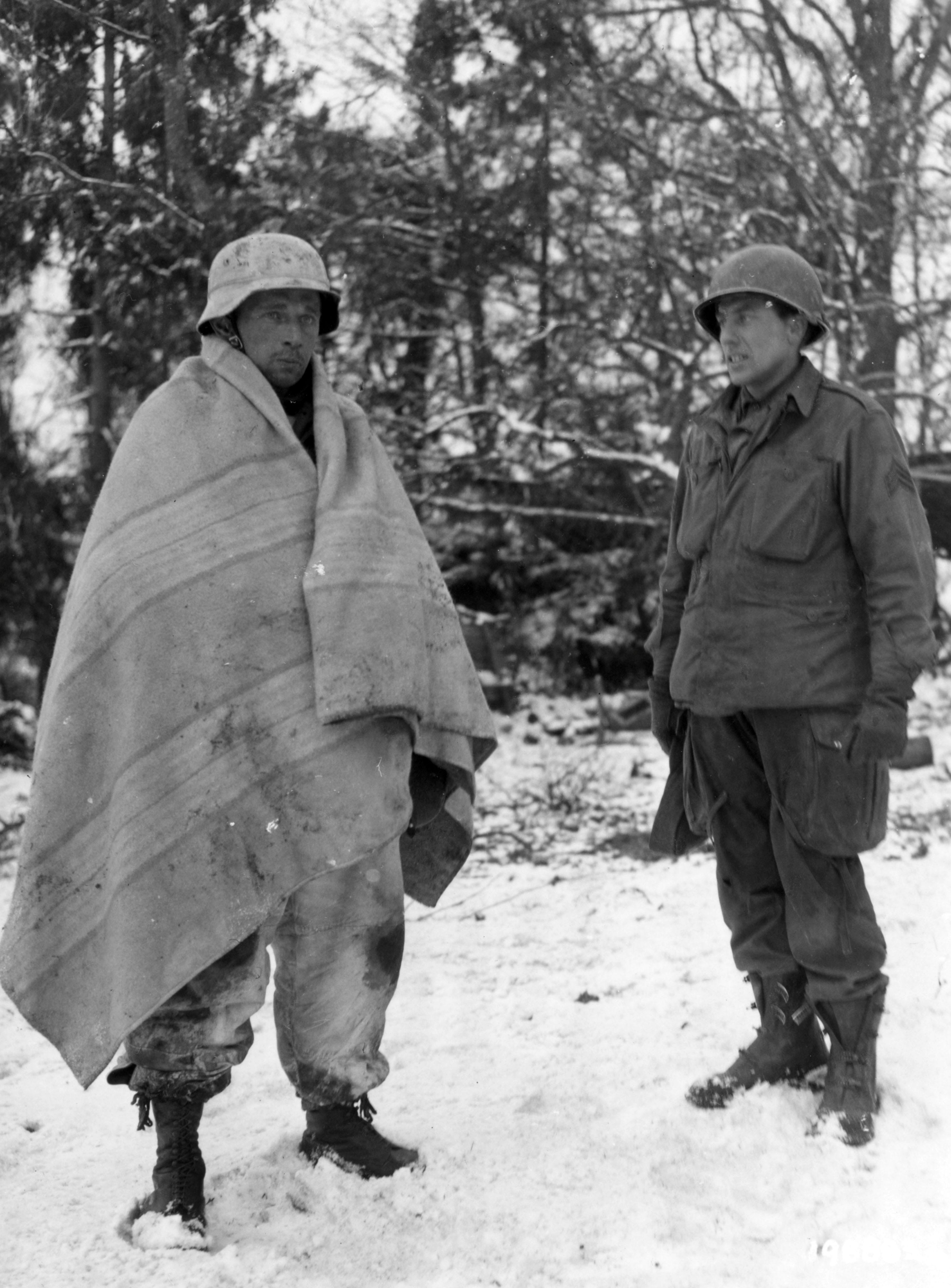
Carter and his fellows were part of C Company and followed B down the hill. Sporadic firing could be heard as they picked their way over the fence lines, becoming gradually more heavy. B Company were soon pinned down, while Carter and the rest in C Company took cover in trees to avoid the sweep of enemy machine-guns.
Dusk descended and then darkness and with it came further orders to move. There was an enemy roadblock up ahead, they were told. They were going to attack alongside B Company, either side of the road. ‘The enemy will be shelled for fifteen minutes before we take off,’ Lieutenant Vern Frisinger told them. ‘We’re going to break through that roadblock, take that town and hold it. That is all men.’
Carter was in the spearhead platoon of thirty-three men. It was nighttime but the flash of thunderous artillery fire flickered and briefly turned darkness into light as they spread out across the open fields. In that moment, they were horribly vulnerable, silhouetted starkly. ‘The air was filled with the yellow glow of hissing 20 mm cannon shells,’ wrote Carter, ‘the sputter of machine guns and the roar of exploding mortar shells dumped on our comrades just behind us.’
Carter’s pal, Raymond Levy, was hit first, when a cannon shell struck his grenades and set him on fire. Engulfed in flames, Carter saw him run back a few yards before becoming an inferno enmeshed on barbed wire. Others were also soon cut down, including both Leon Duquette and Fred Gruneberg – men he’d served with for years. Duquette’s foreboding, as was so often the case, had become a self-fulfilling prophesy. Carter pushed on, though, anger and hatred swelling inside him, and firing his rifle furiously. He and a few others rushed a German half-track spurting cannon shells towards them; this was a light anti-aircraft gun from the Light Flak Battalion 84, so Luftwaffe rather than army but none the less attached to Peiper’s battle group. As they neared and dived into a ditch for cover, Carter realised there were six such cannons not one, each mounted on a half-track, but on the far side of the road was an armoured car that was no longer firing. He wondered whether its gun had jammed and then noticed the turret hatch inching open. Two arms and a sub-machine-gun emerged and suddenly the weapon fired, bullets spitting down onto the road wildly. With the magazine spent, Carter crawled out from his ditch and over to the edge of the armoured car, crouching there, ready to toss a grenade into the hatch next time it opened. Then suddenly, the hatch was opening again but before he could make a move he felt an egg grenade thump him between the shoulders and bounce off onto the road. In an instant, Carter dived back across the road but got himself caught on barbed wire. He was still desperately trying to untangle himself when the grenade exploded and he felt something hit him and numb his shoulder and back.
Despite this, he wriggled free of the wire, fell into a water-filled ditch on top of another trooper, then realised the enemy armoured car was revving its engine and backing up towards him. Panic-stricken, Carter assumed the men inside were after him – after all, why else lob out a grenade unless they’d somehow spotted him. Yet just when he thought his life was over, the hatch opened and three men hurriedly clambered out. ‘I levelled my gun and fired,’ wrote Carter, ‘until they fell either because they were hit or in order to take cover.’
Carter now began crawling back to where he hoped the rest of his company were. Carnage was all around: the dead and dying, an abandoned tank, then another, also apparently knocked-out. It was while he was on his hands and knees that another enemy cannon started pumping shells and moments later he felt a red-hot rip tear through his arm, which made him lose his grip on his rifle. Blood began cascading down his arm. He was now in a bad way, staggering across the field, crying out for a medic, and weakening with every passing moment. ‘Violet and red flashes began to flicker before my eyes,’ he noted. ‘I sank to the ground.’ When he regained consciousness, one of his buddies was applying a tourniquet and then giving him a shot of morphine. Somehow, together, they staggered clear of the fray to the aid station.
As he was being patched up he learned that most of his old platoon had been killed or badly wounded in the attack; only he, Frank Dietrich and George McAllister were still alive and there seemed every probability that Carter might bleed out there and then. He did not, however, although he felt the call of death. ‘What was there to live for?’ he wrote. ‘For three years my buddies had been most of my life. The more than three hundred days of front-line combat had welded our comradeship into a reality which faded civilian memories to dreamy nothingness. Without these brave men alive in the world, I could not conceive much to look forward to. The thought of new faces in the platoon revolted and embittered me. A feeling of bottomless loneliness brought tears to me eyes.’
Now, eighty years on, here I was standing in the same field where Carter and his platoon had been shredded. It was a profoundly moving experience and looking around so much of his account of that fight made sense. I could picture where he’d been, where the armoured car had tried to reverse to the side of the road a little way further along. The fence line, and the sloping hill, and I could picture him struggling on his hands and knees over the sodden ground.
And I’d particularly wanted to visit this spot ever since reading his wonderful memoir, Those Devils in Baggy Pants, one of my favourites to have emerged from the war. He was a natural writer and born story-teller; the narrative feels so unique and original. Carter wrote it over the summer of 1945, soon after his arrival back home from the war. There is reflection in his writing but unlike so many of those written decades later, it has a rawness to it, a greater immediacy, and the sense of loss is still palpable. The passage of time has not had a chance to dim his feelings; rather, his love and admiration for his buddies is fresh, his hurt and sadness at their loss and his anguish for all they went through, very real.
Despite his wounds, Carter recovered sufficiently to rejoin his unit in February 1945, yet of the forty men in his platoon when their war had begun, only two others were still with him at the war’s end. Nor was he to live to old age. In 1946, while still in the army, an old scar on his back became infected and soon developed into cancer. He died, aged just twenty-nine, in April 1947. What a terrible tragedy that was.
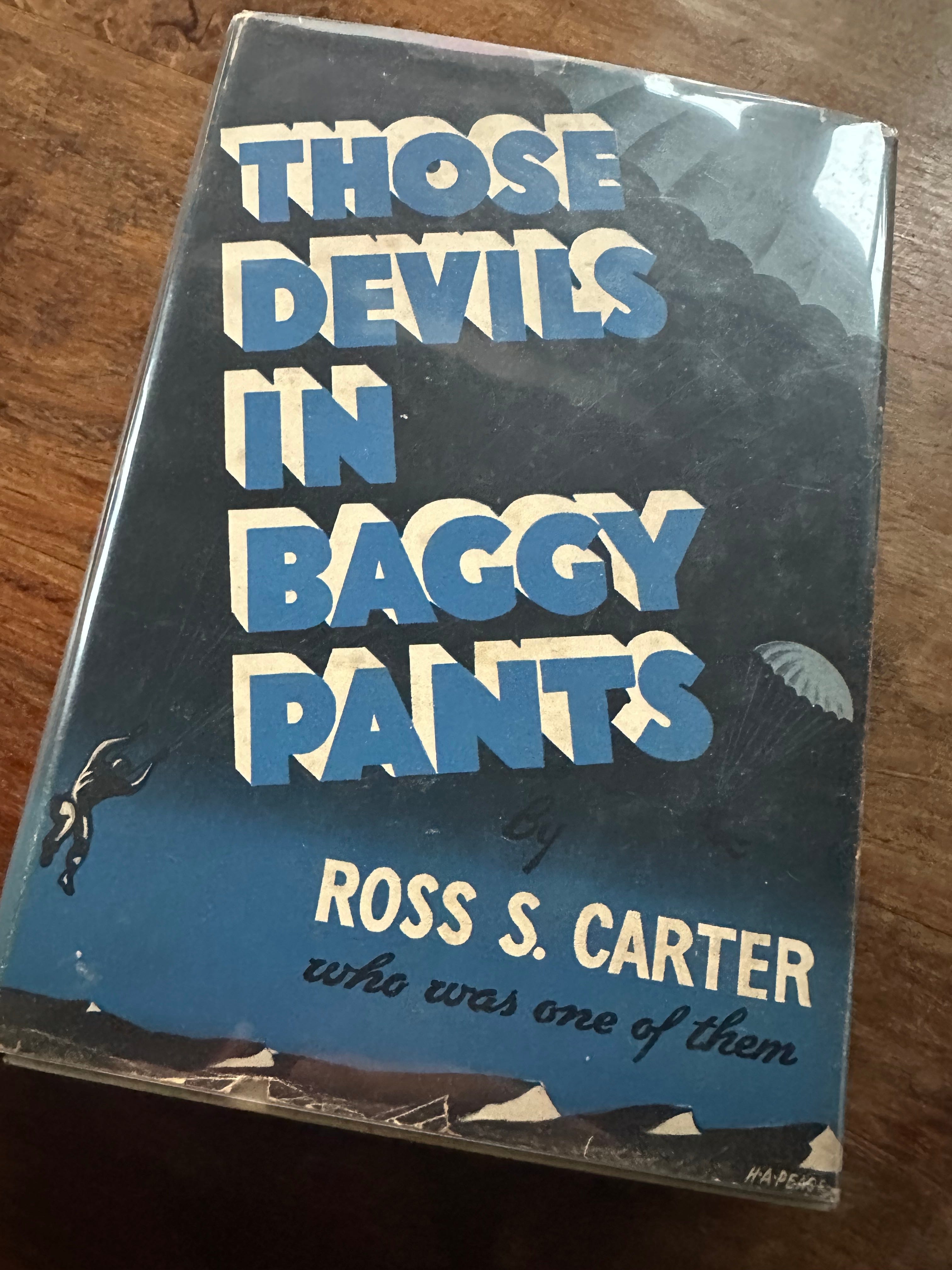
His memoir was published later, in 1951, and sold a million copies. A few days ago, a first edition I’d discovered and bought online from the US, arrived in the post. I’m thrilled with it; the dust jacket is still wrapped around now swathed in cellophane. The 101st Airborne might get all the attention and accolades still, but for me, it was the 82nd All Americans who were the top dogs when it came to American airborne troops, and within that division it’s Carter and his buddies in the 504th who are my favourites. They fought everywhere, were tough as old boots, fearless and aggressive, and they gave it their all. As Carter wrote in the preface of his memoir, he belonged to a legion of doomed men. ‘But death is less bitter when the alternative is slavery,’ he noted. ‘Most of us knew what we were fighting for and we knew how to fight.’ Read his brilliant memoir and you’ll see how right he was.
What a story, what a legend. Thanks James
What a story! One question about ‘Duquette’s foreboding, as was so often the case, had become a self-fulfilling prophesy.’ how much do you think this is recall bias, so when survivors write it up, they recall that one time their (now dead) buddy predicted their death rather than the other times?