Keeping Us Safe
Incompetence Not a Lack of Means is the Real Problem


‘Keeping people safe,’ wrote Andy Burnham this week, ‘is the first responsibility of any government.’ It was also the very first thing Keir Starmer told me and my podcast pal, Al Murray, when we interviewed him last year. They’re both quite correct in stating this, but just what constitutes ‘safe’ is very much open to interpretation. What’s more, it’s an easy thing to say, but as the current PM has discovered, prioritising defence and securing resilient supply lines is tricky in this current day and age of supine and cumbersome government, not to mention while dealing with a Chancellor who refuses to countenance investing to boost economic growth. Since taking power in July 2024, His Majesty’s Treasury sees only gloom and economic doom and repeatedly says the coffers are bare.
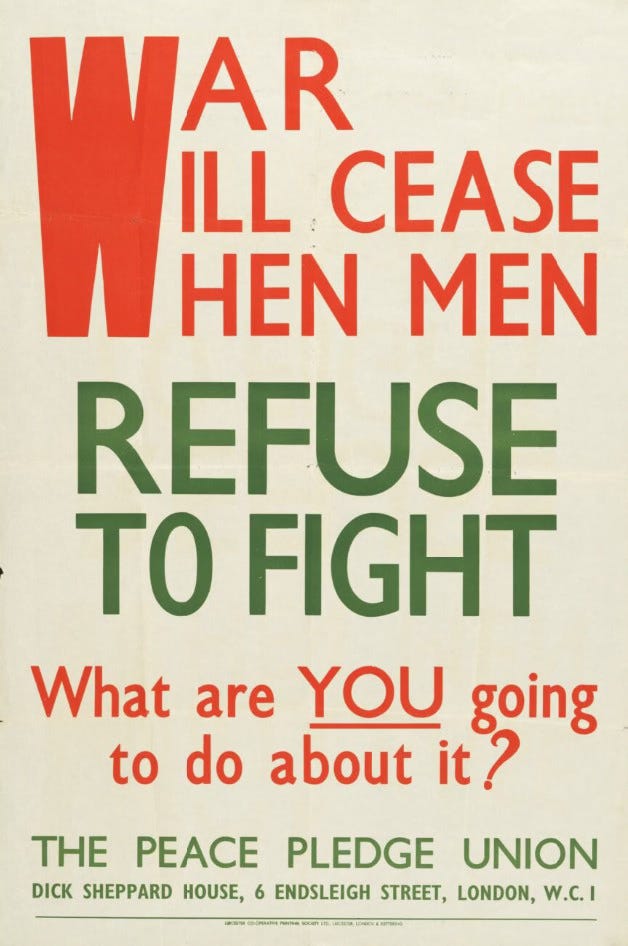
Whether we are now at our 1937 moment, as some have claimed, is a moot point but the dilemmas over how much to spend on defence - and on what - certainly troubled the forerunners of Starmer and Burnham in the 1930s as the country struggled to emerge from the twin economic catastrophes of the First World War and the Great Depression. Balancing the books was far from straightforward, as today’s crop have also discovered. Yet there was one big difference in the UK of the 1920s and thirties to today’s public. Whereas now we are mostly beset by indifference, complacency and a population broadly little interested in the threats we currently face, back then the fear of another war was a matter of nationwide anxiety. The British were fearfully obsessed with the thought of another even more terrible conflict. After all, the Great War of 1914-18 had wiped out much of an entire young generation, and the brutal carnage that modern mechanisation brought to the fragility of the human body and the vast scale of the death and maiming was terrible for the fighting nations to bear, not least Britain. If the last war had been bad, what would a future one look like with even greater means of destruction? Truly apocalyptic was the widely held view. In 1932, Stanley Baldwin had warned that the bomber would always get through, evoking images of wasted cities and millions of deaths. In a speech to the International Peace Society in October 1935, he asked his audience to think of war not as a conflict of massed nations but rather in terms of ‘the lives of our children and grandchildren, of our friends and companions.’ Modern war, he said, risked everything, ‘every piece of all the life we and our fathers have made in this land.’

Public figures from all walks of life waded in. A. A. Milne, the author of Winnie the Pooh, repeatedly wrote and spoke out about the threat of war. ‘There can be no doubt of the destruction,’ he said, ‘all of the greatest and most beautiful cities of Europe and of this country will be shattered and burnt; all the treasures of art and literature will be consumed; most of the machinery crushed to ruins; most of the food supply reduced to desert waste; women and children killed by hundreds and thousands; and men, young and old, by millions.’ Meanwhile, in 1935, Lord Robert Cecil’s League of Nations Union set up a plebiscite, or unofficial ‘Peace Ballot,’ in which almost 12 million Brits signed up to support its work for peace and disarmament.
Before that, Britain had already signed up to a Ten Year Rule in which much of the armed forces would be run down and armaments massively reduced. This came to an end in 1931, and actually, Britain not only developed an advanced defence industry once more but became the world’s leading armaments exporters. The UK then found itself in a somewhat paradoxical state over questions of peace and war. Baldwin, then his successor, Neville Chamberlain, repeatedly stressed how they were straining every sinew to prevent war whilst accepting it was also their duty to prepare for this ghastly eventuality. Chamberlain always believed that war had to be avoidable and yet on the morning of Sunday, 3 September 1939, found himself broadcasting to the nation the terrible, gut-wrenching news that Britain was, once again, at war with Germany.
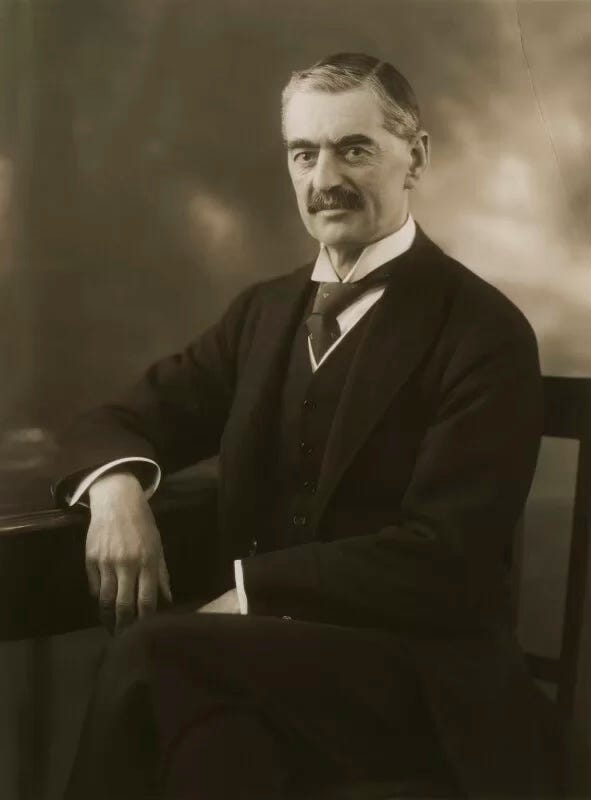
In fact, it was Chamberlain, as Chancellor of the Exchequer who had, in 1935, kick-started major rearmament and who had, rightly, prioritised the burgeoning RAF and upgrading the Royal Navy over the Army. Back then, however, Prime Minister and Chancellor had worked closely together, with Chamberlain very much on the same peg as Baldwin in terms of the urgent need to invest in defence. As Warren Fisher, then the Permanent Secretary noted, the Treasury’s function was to act as a ‘candid friend’ rather than an ‘abominable no-man.’ It was certainly important to ask sharp and tough questions but ultimately, it was the Chancellor’s job to do the Prime Minister’s and the government’s bidding as far as humanly possible, and not least in terms of defence. In fact, as Chancellor, Chamberlain had proved remarkably progressive, stimulating the economy with immense building projects and overseeing economic growth rather than stifling stagnation as Britain emerged from economic mire. Had he not been the first wartime PM, deposed following disaster in Norway, he would probably be far better remembered as the hugely skillful politician and reformer he undoubtedly was.
Fast forward to 1982 and the Falklands Crisis. Then, as now, Britain was in the economic mire and the Treasury was hellbent on retrenchment and cutting back on defence, including the decommissioning of the Antarctic patrol ship, HMS Endurance. It was one of the main reasons why Argentina felt emboldened to invade; weakness when it comes to defence only encourages enemies, as history has repeatedly shown. With the Argentinians on British soil, however, Thatcher overruled the Treasury, excluding them from meetings and telling them bluntly to start writing the cheques. Not only did they do so, creating a £3 billion black hole, Britain won the war and emerged into a period of sustained economic growth. As the United States discovered during World War II, and as Poland is learning now, immense increases in defence spending can prove a springboard to significant upturns in the economy.
Which leads us to where we find ourselves now. Starmer is not prepared to overrule his Chancellor and no-one within the Treasury seems to have either the vision or inclination or imagination to turn us from military laughing stock into a nation that takes defence, security and resilience - the raw material of deterrence - seriously or recognise the terrible threats we now face. After all, if those in the thirties feared the apocalyptic threat of a future war in a time where nuclear weapons remained the science of the future, what do we face now? Inter-ballistic missiles, hypersonic missiles, tactical and strategic nuclear warheads, the crippling of supply lines, and, as A. A. Milne predicted, starvation. Our financial systems brought to a standstill. So too energy supplies.
Doom-mongering fancy? Not a bit of it. Unlikely, perhaps, but certainly all possible and without question there are those in the world today both capable of unleashing such horrors and who currently wish that upon us. Anyone in the UK today not taking our defence very, very seriously is being grossly irresponsible. It is simply not worth the risk. Not on any level and the sooner our politicians and wider public understand this, as those understood it in the 1930s, the better.
What’s more those who do claim that defence spending is a shoot-out with welfare costs are totally missing the point. If the worst happens, or even if one or more of those all-important cables in the North Sea get cut, then there won’t be any welfare at all. Or a functioning NHS. Or banks working. Society as we know it would break down, and that’s before any talk of missiles raining down on our territory. Right now, we’re not prepared for this. Hence the urgency.
As I have repeatedly written in these pages, there are ways and means of funding this. Top of the pile is the Defence, Security & Resilience Bank - DSRB - a British idea formulated on the same principles as the European Bank for Reconstruction and Development - EBRD - and the World Bank. In other words, it depends on bond markets to raise debt capital from its member nations - who then collectively own the bank. Members are like-minded, democratic nations, and loans are awarded at triple-A level assurance, at super low-interest and granted over a long period of time. In other words, the DSRB is offering long-term, low-cost financing. It is also using that capital - or funds - to provide 80% guarantees on any investments in the deterrence field to the banks and funds of its member state. This means the DSRB will be unleashing tens of billions of private investments into defence companies that would otherwise struggle to find anything other than high interest ‘Dragon’s Den’ style venture capitalists financing on a day-to-day basis - the kind of high-risk funding that understandably deters many potential projects. Money can now be loaned to national governments or private companies through one single, coordinated, global institution that has been given the freedom to invest across the whole spectrum of defence, security and resilience – up to and including lethal weapons and capabilities that really would make our adversaries think twice.
Obviously, the more member nations there are, the stronger and more effective the DSRB becomes, which is why the announcement of nine founder-members at the NATO conference this week is so significant. Leading the charge for the DSRB has been Mark Carney, a highly experienced and skillful economist before becoming Canada’s Prime Minister and also the former Governor of the Bank of England, but also Luxembourg’s Prime Minister Luc Frieden, an immensely successful financier in his own right. Needless to say, Carney and Frieden’s backing has given the DSRB enormous clout and credibility. Canada and Luxembourg have been joined by Albania, Greece, Belgium, Latvia,Romania, Turkey and, perhaps most impressively, Ukraine. Canada will become the global lead nation, while Luxembourg will hold the European headquarters and operational centre, as one of the world’s leading global bond issuers. Others are soon to follow, making it a formidable defence funding scheme for the west - and one that can provide investment, jobs, economic growth and, most importantly of all, make us safer.
The obvious question, though, is why it is Canada now hosting the DSRB rather than Britain, since it was a British enterprise in the first place? Unfortunately, Britain’s absence is not for want of trying by the DSRB Development Group leadership team. The Treasury refused to back it from the outset, preferring instead to champion an alternative Finance Ministry-controlled funding mechanism, the Multilateral Defence Mechanism - MDM - yet to launch but with Finland, Poland and the Netherlands currently attached. Why the British government didn’t back the home-grown DSRB is anyone’s guess, but prime amongst the reasons seems to be that those in the Treasury didn’t think of it and for some reasons mistrusted an enterprise for which they didn’t have creative control.
This decision has probably cost the City of London, backers of the DSRB from the start, around 3,500 jobs and the associated growth. In the meantime, there have been repeated opportunities for the Treasury to read the room, realise that the DSRB was winning the race, and so climb down and come on board alongside Canada and Luxembourg, none of which they’ve taken. Andrew Kinniburgh, Director General of Make UK Defence, a leading national not-for-profit defence trade association, has been just one of those clutching their hair in frustration. The Government’s decision not to join the DSRB, he said, is bad for British business and bad for British security. ‘We have long argued,’ he said this week, ‘that the UK should be leading from the front alongside Canada to set up the DSRB, and instead we will now be playing catch-up. In the meantime, we will lose out on a cheap source of funding to boost defence spending and UK industry will be locked out of global DSRB-funded programmes by allies.’ He’s absolutely spot on; the DSRB will create allied defence markets well beyond anything the European Union has so far been able to muster, because it is going global and will not be constrained only to European or NATO members.
How could we have been so breathtakingly short-sighted? To make matters worse, I’ve been informed that the Chancellor, Rachel Reeves, spent the weekend before the NATO summit trying to undermine the DSRB and urging fellow NATO members to join the MDM instead. This badly backfired, not least with the Canadians and the otherEuropean founder members of the DSRB, who were understandably massively unimpressed by this attempted sabotage. Reeves’s failure to win over nations to the MDM then prompted a rapid backtrack and a public announcement in the Financial Times that both funding mechanisms should work side by side. Reeves is now saying the DSRB and MDM are offering different things and that both have value. Not really. It would be far better to have just one such funding mechanism and that’s clearly the DSRB because it’s at a more advanced stage, actually functioning and now has significant founder nations.
Later in the week, on Wednesday 8 July, Parliament held a joint session of the Treasury & Defence Committee in which Labour MP, Alex Baker, grilled Lucy Rigby, the Chief Secretary to the Treasury, and Luke Pollard, the Minister for Defence Readiness and Industry. Watching the video coverage of this session makes for excruciating viewing as Rigby and Pollard reveal they haven’t read up on the DSRB, have no idea about its charter and little comprehension of the importance of what is at stake. Also, the Treasury in its haste to gain control of defence procurement spending at home and across fellow Joint Expeditionary Force partners, seemingly forgot that NATO already has its own joint procurement mechanism in the NATO Support and Procurement Agency (NSPA). This not only delivers stocks and stockpiles tax-free but has been doing so successfully for decades. ‘My actual worry, Chief Secretary,’ Alex Baker said, not unreasonably, ‘is that you just don’t know the facilities that are there. I just think that actually we’re pretty dismissive of NATO facilities. We think we know best.’
Alex Baker has got to the nub of it: that the Treasury’s decision-making is clouded by hubris, arrogance and a staggering lack of geo-political clarity. Just how out of their depth are they in this new world in which we live? Clearly, however, it now makes far more sense to back an existing NATO agency and a new global financing mechanism that is up and running with nine countries as members and counting, rather than one that exists only in ‘non-paper’ imagination at present. Yet to make matters worse, the Treasury is now desperately trying to rescue the MDM by reportedly throwing a significant amount of tax payers’ money at a well-known consultancy to try and make it work, despite having only four nations pledged - rather than signed - to join, and which are also already members of the NATO Support & Procurement Agency.
It’s bonkers, and surely, the most sensible, logical solution is to kick the MDM into the long grass and get fully behind the DSRB before it’s too late. Other nations are imminently preparing to announce their own membership of the DSRB; unity of purpose and strength in numbers are key to its future success and now that nine nations have signed up, it is flourishing. Momentum is everything and it’s not with the MDM. Rachel Reeves is currently trying to sweep the mess under the carpet and has now admitted her department is in talks with Canada to merge the MDM with the DSRB. However, merging a procurement mechanism with a financing mechanism isn’t easy – they do different things. And by the way, this is the same Treasury department that spectacularly failed to deliver a similar opportunity for UK defence businesses, namely the 150 billion Euro Security Action For Europe, or SAFE loan mechanism. Of course, Canada also joined this European initiative. It’s depressing to realise that the department responsible for the nation’s finance can be quite this underhand and incompetent. Rachel Reeves should recognise the MDM is a dead duck and sign up to the DSRB as soon as possible before Britain is truly left behind. And if not Reeves, then this is the urgent course of action that needs to be taken by the incoming Chancellor, whoever he or she may be.
So, this is where there is the fundamental difference between the Treasury and defence requirement now and back in the 1930s: that the current Chancellor and her advisors do not understand the fundamentals of defence and are determined to maintain, indeed enhance, an iron-grip of control even though to do so harms Britain both in terms of what can be achieved but also diplomatically as well. And unlike in 1982, we currently do not have a Prime Minister willing to show who’s boss.
None the less, change is in the air. It is unquestionably a good thing that the DSRB is now up and running, it is also something that the Chancellor is reining back on the MDM and it is also encouraging that Prime Minister-in-waiting, Andy Burnham, appears keenly aware of the urgent importance of defence. Quick wins and solutions are staring us in the face. Pragmatic and clear-headed common sense can ensure we follow those of the thirties: yearning for peace but preparing for war.
So, if I'm interpreting the article correctly, the greatest threat to UK security is currently... the UK Treasury?
I think the DSRB is a great idea. The UK is well poised to lead in future drone technology given we already have not just an established defence sector but also have established players in many key areas eg carbon fibre manufacturing, advanced spread spectrum communications, AI, etc.
It would be amazing to see investment in UK innovation, at reasonable rates, with hopefully a higher risk appetite to fund cutting edge research (that doesn't always pay off) rather than the incredibly risk adverse UK finance sector that only seems to want to pile in once all the risk has been taken out.
And we wonder why we end up taking offshore investment that guarantees that much of the benefit, financial or otherwise, also flows straight back overseas and not into the UK economy.
I'd also like to see an honest discussion of the where the real *risks* lies.
Sure, Putin et al pose a credible threat, particularly if their cyber capabilities are as advanced as the thriller writers would have us believe, and that worries me far more than their kinetic capabilities, but if we're being honest, the greatest harms to the UK in recent years have come from our so-called Allies eg the effect on oil prices from Trump's Iran fiasco, the destructive effects of social media on mental health, Cambridge Analytica, the disastrous effect of delaying action on climate change due to a concerted, well-funded, campaign of climate change denialism, etc.
Drones, 6th gen aircraft, advanced missiles etc are all sexy stuff to show off at a trade show, but media ownership reform, CNI hardening, climate change adaptation and mitigation, food security, energy security, and all the rests are as important as weapons, if not more.
I truly hope people in power are reading these James.
I think, with a little bravery, a willingness to stop and reset parts of Government, and a clear appreciation of the scale of the threat, there are some fundamental changes we could and should make.
1. A Cross-Party National Defence Settlement
Agree a rolling 10–15-year National Defence Settlement covering the UK’s strategic objectives, force structure, sovereign industrial capabilities, equipment priorities, resilience, reserves, skills and funding assumptions. Governments could change it, but only by explaining the strategic, military and financial consequences to Parliament.
This would replace the cycle of successive defence reviews that partially overwrite one another and would provide continuity across departments that are currently not used to working together.
2. A Permanent National Defence Council
Create a standing National Defence Council, chaired by the Prime Minister, bringing together Defence, Treasury, Cabinet Office, Business and Education, the Armed Forces, industry and resilience experts.
Its role would be to align military strategy, procurement, industrial policy, infrastructure, skills and national resilience, with annual priorities and progress reports to maintain momentum beyond ministerial reshuffles.
3. Longer-Term Defence Leadership
Key defence ministerial appointments should normally last three to four years, with early changes explained to Parliament. The same principle should apply to senior officials and programme leaders. Complex programmes cannot succeed if leadership changes every few years.
4. Proper Preparation for Ministers
Incoming Defence Ministers should receive structured training in strategy, procurement, industry, Treasury processes and military capability, alongside visits to operational units and industry. Shadow teams should receive security-cleared briefings before entering government.
5. Separate Strategy from Politics
Ministers should decide the destination, not continually redesign the vehicle. A permanent Defence Strategy and Capability Office should maintain long-term capability plans, industrial mapping, workforce forecasts and lessons learned, providing an institutional memory that survives changes of government.
6. Stable Procurement
Major programmes should begin with binding capability agreements defining outcomes, costs, timescales, risks and what is out of scope. Any changes should openly publish the cost and schedule impact, discouraging endless requirement creep.
7. Give Industry Confidence
Publish a funded ten-year Defence Industrial Demand Plan so industry can invest with confidence. Stable, multi-year production pipelines are more efficient than repeated short-term competitions.
8. Strengthen Parliamentary Continuity
Provide Parliament with a permanent Defence Programme Office to track major programmes over decades, retain expertise and hold governments to long-term commitments regardless of ministerial changes.
9. Reward Honesty
Change the culture so people are rewarded for identifying problems early, producing realistic costings and stopping failing programmes, rather than simply getting projects approved.
10. Make Defence a National Endeavour
Create a permanent Defence and National Resilience Programme linking schools, cadets, universities, employers, local government, industry, veterans and the voluntary sector. Public engagement should be treated as national infrastructure, not an occasional recruitment campaign.
The essential cultural shift is from “every new leader must announce something different” to “every leader should strengthen what works, fix what doesn’t and leave the institution stronger than they found it.”
The model is straightforward:
Cross-party strategy → stable leadership → institutional memory → funded industrial pipelines → disciplined procurement → sustained societal engagement.
My fear is that Whitehall is too busy driving the car to stop and refuel. Worse still, the last petrol station ran out years ago, everyone knows the supply chain is broken, but no one has either the authority or the appetite to fix it. So we simply keep driving, hoping momentum will carry us a little further.