How Could They Fall For It?
Understanding Why People Follow Hitler and Other Malevolent Wrecking Balls

In the run-up to the German invasion of Poland in September 1939, most people in Germany believed what was being put about both on radio and in the state-controlled press, namely that the Poles were committing all kinds of atrocities to former Prussians living in Poland, that they were war-mongering and using threatening language, and that not only was the Danzig corridor rightfully part of Germany, it was the duty of the Reich to defend those subjects living there.
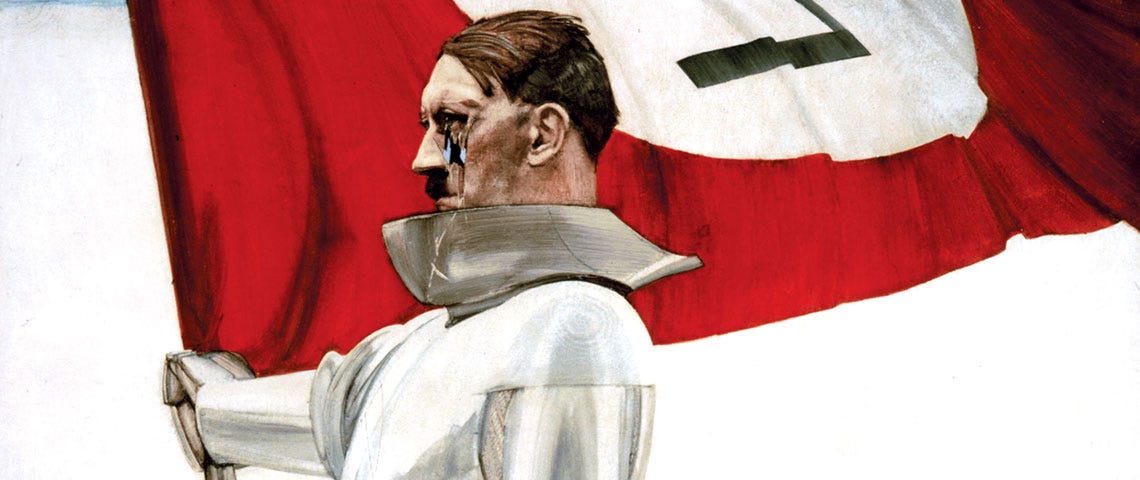
Eighteen year-old Heinz Knocke was from Hameln in central Germany and typical of many of his age. He had absolute faith in the Führer and the rightness of the German cause. Planning to join the Luftwaffe as a pilot, he had had his preliminary examinations and was hoping that with war imminent, his call-up would be accelerated. ‘The Polish atrocities against the German minority make horrible reading today,’ he scribbled in his diary on 31st August. ‘Thousands are being massacred daily in territory which had once been part of Germany.’
Oberleutnant Hajo Herrmann, a twenty-four year-old pilot with the bomber group III/KG4, also thought the Poles had brought war upon themselves. As far as he was concerned, the Danzig issue was one of principle. It had been German before 1919, was still inhabited mostly by Germans, and since the Poles had rejected any peaceful solution, what did they expect? ‘The anger that I felt inside at their unreasonableness,’ he noted, ‘matched my sacred conviction: that of German rightness.’ For Oberleutnant Hans von Luck, on the other hand, an officer in the 7th Armoured Reconnaissance Regiment, the escalating situation had brought a sudden recall from leave just a few days’ earlier. He had found everyone at the garrison in Bad Kissingen near Schweinfurt in high spirits. Neither he nor his friends believed a word of Goebbels’ propaganda about the Poles, but they did believe Danzig and the corridor should be part of Germany once more. ‘We were not hungry for war,’ von Luck noted, ‘but we did not believe the British and French would come to Poland’s defence.’ How wrong he was; for while Von Luck may have understood that going to war was not a matter to be taken lightly, even he had blindly accepted Hitler’s assurances that Britain and France were bluffing. It was a feature of Hitler’s rule that he frequently said one thing with immense conviction and authority but quite another once events had been proved him wrong. Such was his grip on the German people, however, almost no-one ever questioned this, and certainly not his inner circle or anyone in the German media. At any rate, all three of these young men had believed parts of the nonsense that had been spouted by Nazi propaganda, whether it be false claims about the Poles, the justness of the Nazi cause for invasion, or Hitler’s assurances the British and French were bluffing. Such was he power of Nazi disinformation.
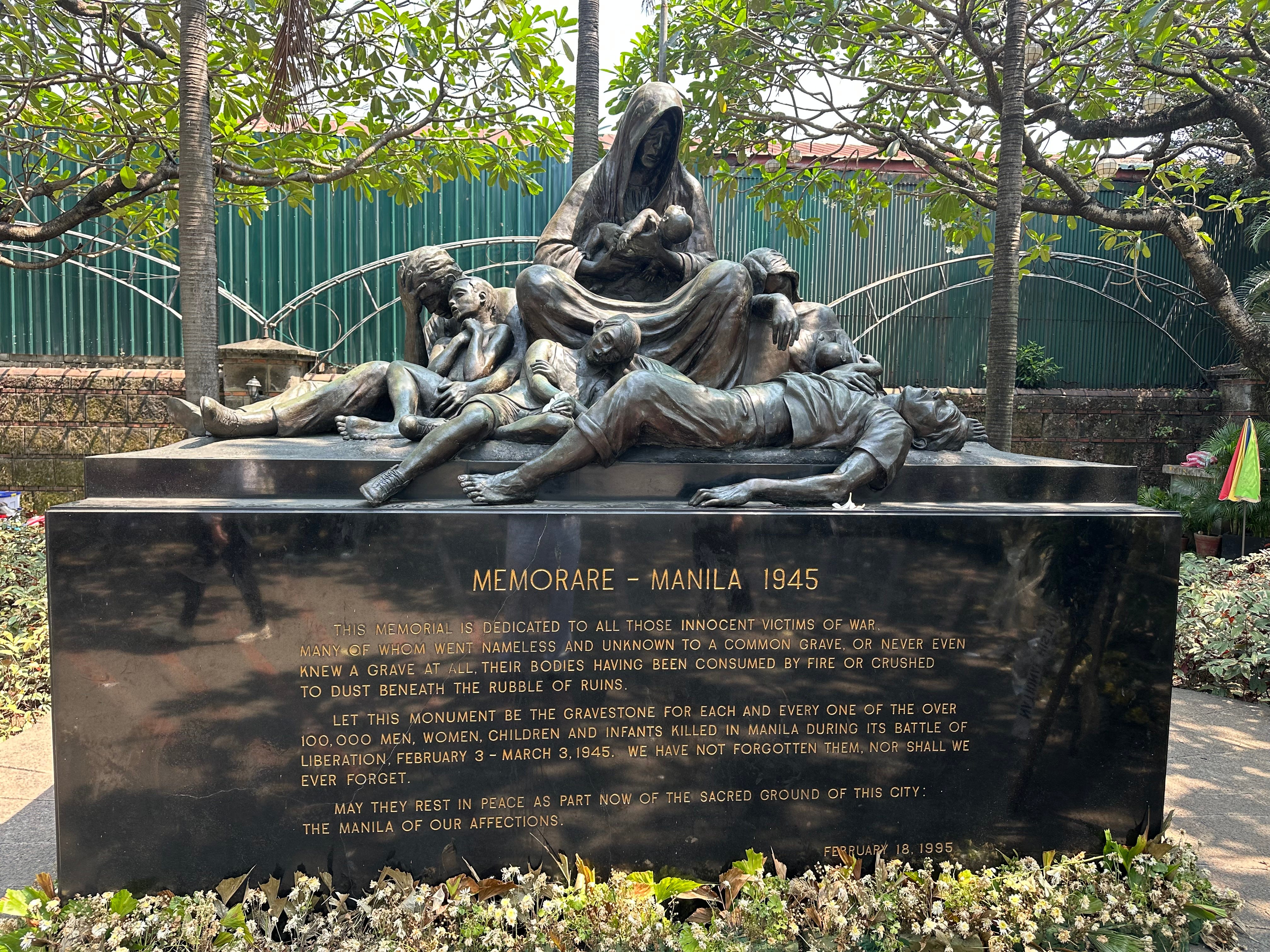
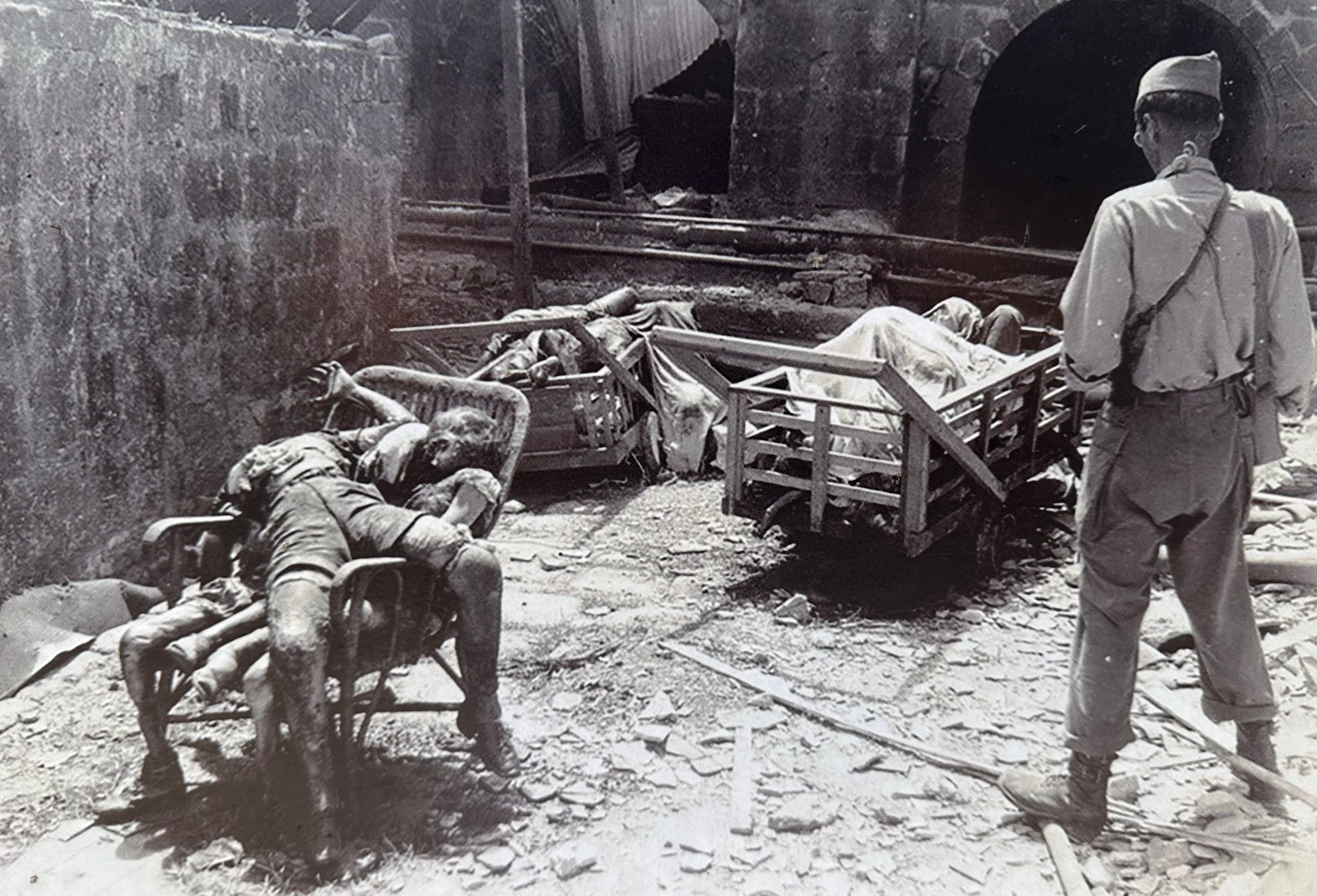
I’ve been in Manila in the Philippines recently and managed to spend some time touring the old city. The centuries-old, Spanish-built walled city of Intramuros and the immediate expanding urban spread around around it had been a beautiful place, so much so that Manila was widely known as the ‘Pearl of the Orient.’ Tragically for Manila and even more so for its Filipino inhabitants, some 17,500 Japanese troops decided to defend it to the death in February 1945 and what’s more, destroy it completely before they breathed their last. Even worse, they also decided to slaughter as many of the local inhabitants as they could, mostly by stabbing, skewering, and burning them alive, so as to save precious bullets they needed for the American liberators. The Japanese troops also gang-raped and mutilated a large number of women and teenage girls too. The scale of their cruelty is hard to comprehend. Large religious and civic buildings - the cathedral, numerous churches, the Post Office, Legislature, and St Paul’s College to name but a few - were all booby trapped and destroyed while the 160-acre Walled City was systematically razed to the ground. The defenders were short of bullets but not high-octane fuel, swords or bayonets. Over 100,000 Manilenos were killed in that terrible 29-day battle.
The actions of these Japanese troops were symptomatic of the death cult that had increasingly gripped Imperial Japanduring the 1930s. Ultra-nationalistic militarism had taken root in the face of growing economic crisis. Most despotic and authoritarian regimes tend to draw upon the past in a form of warped nostalgia. The Japanese had cast out the ancient Shogunate during the Meiji Restoration of the 1868. In place of old notions of Samurai honour codes had come a single emperor, rapid urbanisation and a dramatic lurch to modernity. In the First World War, Japan had sided with the Allies and had aspired to becoming an economic powerhouse in the Asian-Pacific region. Humiliation during the Treaty of Versailles that followed and then the catastrophic global economic depression had sent Japan down this different root, however: more aggressive, more racist, more militaristic and all wrapped up in an entirely new system of honour drawn from an earlier Samurai age but with its own twisted version for the new era in which they found themselves. The ‘Bushido code’ had only first been formerly introduced into common usage in 1899, when Natobi Inazu wrote Bushido: The Soul of Japan. This brought a number of old samurai codes of honour into one cure-all phrase, and while it referred to notions of honour, behaviour and even self-sacrifice, the Japan that emerged in the first pat of the 20th century treated prisoners of war well and in accordance with the Hague Convention of 1899, while the civilian government encouraged greater westernisation in terms of culture and behaviour.
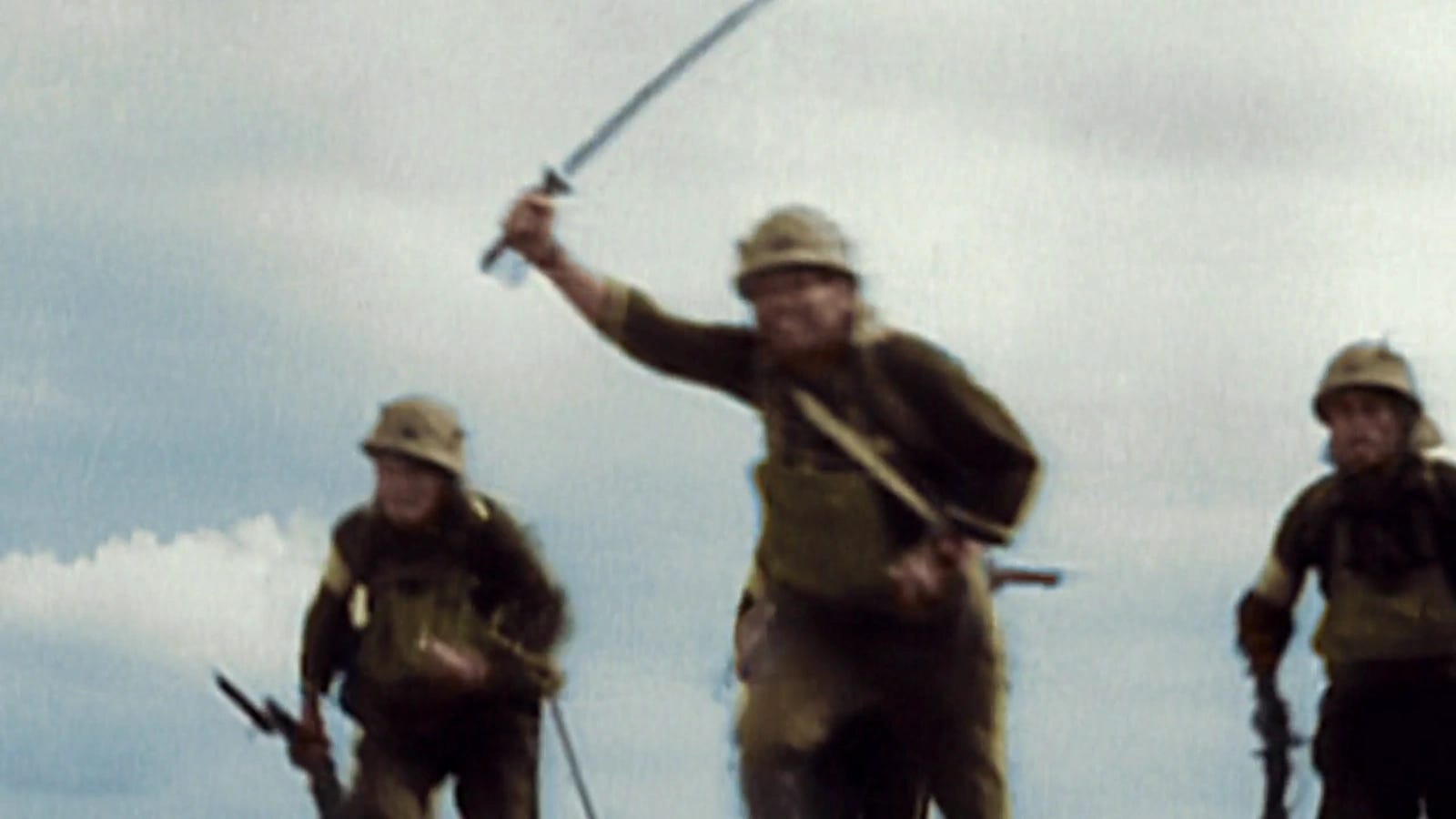
The Bushido Code adopted by the military government of the 1930s cherry-picked certain features of the old samurai notions of honour, but also taught racial superiority and that brutality and strict obedience were part and parcel of national strength. It also claimed that the ultimate honour was to lay down one’s life for the Emperor, that there was nothing to fear from death and that any kind of surrender was a stain of dishonour for both the individual and his family. Brutalising recruits in all the armed services turned Japanese troops into automatons, while they also became enured to extreme violence. Traditional Samurai swords became de rigeur for officers and were used with abandon, stabbing and slashing and slicing off heads in a grotesque orgy of bloodshed. Physical and mental weakness was not to be tolerated. Decent men who had hitherto embraced modernisation and westernisation now turned back the clock to a mythical earlier Japanese era as a means of the Japanese military government collectively coercing the people into doing their bidding. Many were turned into monsters who embraced deep cruelty, violence and self-sacrifice as badges of honour.
For many years, I always found it hard to understand how so many Japanese could have possibly gone along with such a dramatic embracing of violent ultra-nationalism, not least because such notions were at odds with Shintoism and Buddhism, the main religions of Japan. Of course, lots did not, but more than enough did, which allowed their armed forces to continue fighting - and committing unspeakable war crimes - long after they had had any conceivable chance of turning their dwindling fortunes in the war. How could such a culturally and historical rich and sophisticated nation have become so warped, so twisted, so quickly?
And for many years, I wondered in disbelief at the Germans too. After all, they brought us Luther, Goethe, Beethoven, Bach and Marx. They produced some of the most brilliant scientific minds, greatest engineers, and political titans like Otto Von Bismarck. What had happened during those twelve, dark years of Nazi rule? How had such a large proportion of the nation fallen for Hitler’s rhetoric and hate-fuelled world view? From the prism of the first decade or so of the 21st century, it all seemed fantastical and I couldn’t imagine how the world could ever descend to such misguided nonsense ever again - or, at least, not in the democratic world, at any rate. Sophisticated, modern, progressive nations couldn’t possibly go down that route once more.
Both the Imperial Japanese and the Nazis dominated the new forms of media communication emerging in the 1930s. Propaganda had been a key component of Nazi politics from the outset, and while there were some who had not been persuaded, it had been unquestionably hugely effective, not just within the Reich but around the world too.To a large degree, this was due to Dr Josef Goebbels, the Reich Minister for Popular Enlightenment and Propaganda, and Gauleiter – administrative leader - of Berlin, an old Frankish term that had been resurrected by the Nazis. A former failed journalist and one of the first Nazis, he was utterly devoted to Hitler, so much so he had even given up an affair with a Czech film star with whom he was deeply in love because the Führer asked him to. Although the son of a shop assistant, Goebbels was highly intelligent and despite those humble beginnings had attended several universities and gained a doctorate. Marriage to Magda Quant, a society divorcee, gave him the kind of money and status he needed to help him climb up the Nazi ladder. He had become Propaganda Minister in 1933, the year Hitler became Chancellor, and had immediately announced his prime goal was to achieve the ‘mobilisation of mind and spirit’ of the German people. ‘We did not lose the war because our artillery gave out,’ he said of defeat in 1918, ‘but because the weapons of our minds did not fire.’
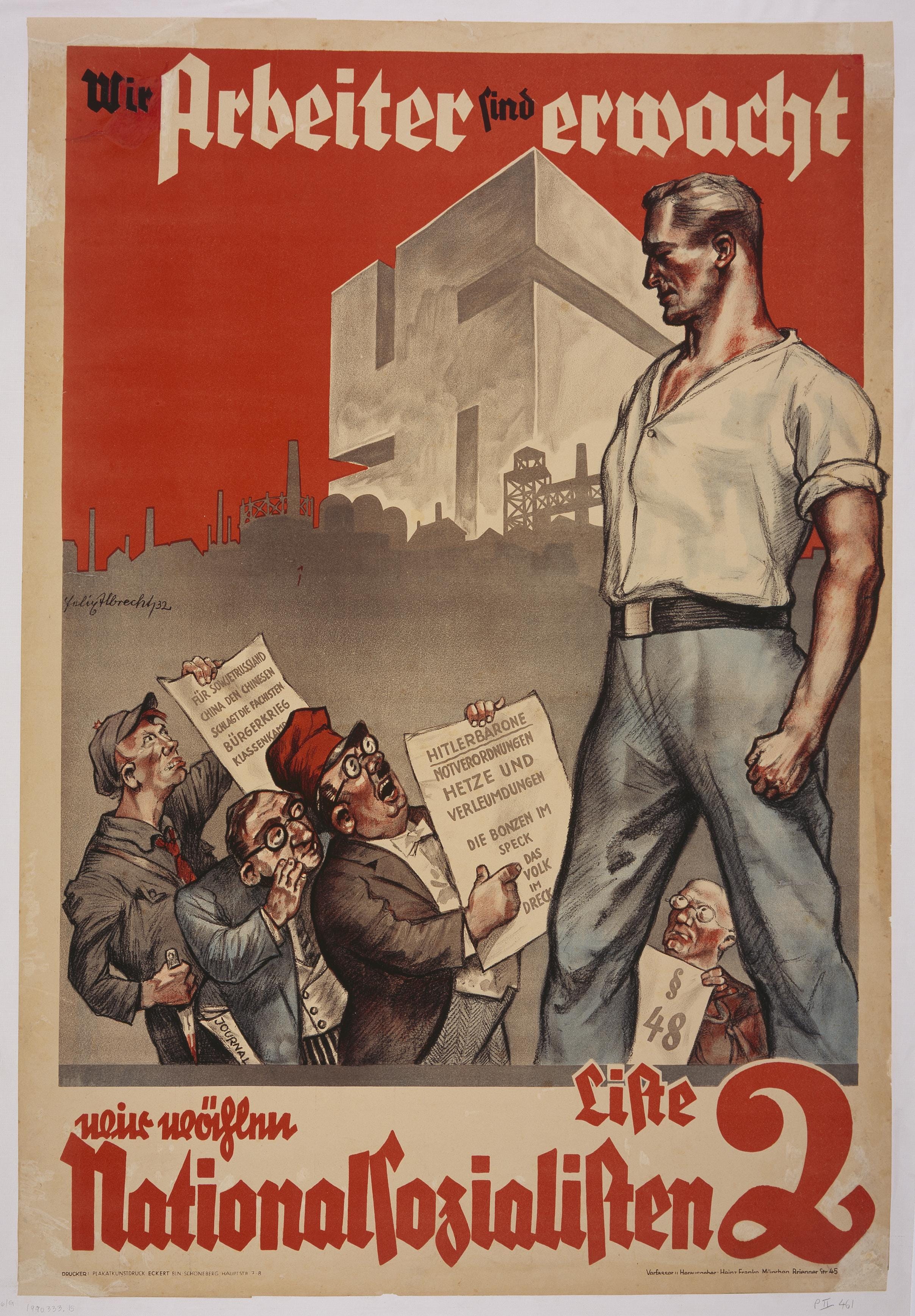
In many ways, Goebbels was as responsible for Hitler’s position as Hitler was himself and he was the man who had largely shaped the Nazis public image. It was he had insisted on draping swastikas – the bigger the better – from as many places as possible; it was he who taught Hitler how to whip a crowd into a frenzy; it was also Goebbels who had elevated Hitler into a demigod in the eyes of many. He knew all about manipulation theories, orchestrated heavy-handed mob violence, and in the 1933 election created the ‘Hitler over Germany’ campaign; it was the first time, for example, that aircraft had been used to take a candidate around a country in an effort to reach more people. It worked spectacularly well.
With the Nazis in power, Goebbels had also done much to stoke up the virulent anti-Semitism that lay at the heart of Nazi ideology and had done much to turn Nazism into a form of surrogate religion, in which, again, drawing on nostalgia, they had harked back to a ‘purer’ Aryan past to help bind the people both together and behind the Party and, more importantly, the Leader. Goebbels’ influence – his genius – should never be underestimated.

Goebbels had masterminded a cunning way of getting the prescribed message across. ‘Repeat, repeat, repeat,’ was a favourite mantra. And the means of this repetition was, above all, the medium of radio. There were many innovations of the 1930s in which Germany lagged behind other leading countries in the world, but the embracing of radio sets was not one of them. Goebbels had realised that radio was the ideal way to get across his message and so was instrumental in making sure radio sets were both cheap and accessible. First up into the mass market was the Volksempfänger – the ‘People’s Receiver.’ Using the word ‘Volk’ was another Nazi trick, which suggested togetherness rather than exclusivity. This was later followed by the DKE, or Deutscher Kleinempfänger, the ‘German Little Receiver’, which, as its name implied was both pioneeringly small and also affordable. The net result was that by 1939, almost 70% of the population owned radios. For those remaining 30% still without one, however, there were communal listening points: in cafés, bars, restaurants, the stairwells of blocks of flats, the corner of town squares with accompanying loud speakers. Radio coverage in Germany was more dense than anywhere else in the world, including the United States, the most modern country in the world. Finally, to really ram home the message, there were radio wardens to coax people into listening to key speeches and programmes, all of which were mixed in between unceasing light music, martial marches, Wagner and popular entertainment. ‘Radio must reach all,’ claimed Hans Fritsche, the Nazis chief radio commentator, ‘or it will reach none.’
Alongside radio, there were news films shown at every cinema, and movies that equally promoted Nazi ideology: Jews were played as villainous, duplicitous and money-grabbing, the heroes were tall, broad, blonde and fulfilling the Aryan ideal. There were documentaries too, like Leni Riefenstahl’s Triumph of the Will, about the 1934 Nazi rally at Nuremberg. Cinema goers had grown massively through the 1930s, from 250,000 in 1933 to three times that number by 1939.
Finally, there were state-controlled newspapers. Every city had one and there were national ones too, not least the principle party mouthpiece, the Völkische Beobachter, the People’s Observer. One of Goebbels’ key instructions to journalists was to make the writing more readable, more conversational and less dry. Again, it was a policy that worked a treat; the Völkische Beobachter had climbed from a circulation of 116,000 in 1932, to almost a million by 1939. The result was that very few in Nazi Germany could avoid hearing the oft-repeated propaganda put about by Goebbels and his carefully orchestrated team at the Propaganda Ministry. So, everyone was hearing the same bilge, and added to that, Hitler and the Nazis had got back much of the territory they’d lost in 1919 all without a shot being fired. There were jobs, a return of national pride and it felt as though Germany was returning to the kind of militarism that had marked the First Reich created by Bismarck and for which the Prussians then Germans had always had such a fine reputation. Nazi uniforms even harked back to that earlier era with plenty of leather, sartorially sharp uniforms and an imperial eagle, albeit one whose head was now looking the other way and its talons clutching a swastika.
The vast majority of Germans had fallen for this sustained media campaign, hook, line and sinker and were in thrall to Hitler and to the Nazi regime, even though the entire edifice was built on the shakiest foundations, had a truly despicable and cruel ideology hard-baked into its core, and involved whole-scale corruption and systemic lying at every turn. The majority of Germans believed Hitler, bought into his warped ideology and played along with the fiction that Jews were an inferior race rather than the black and white reality that Judaism was and remains a religion and nothing to do with ethnicity. The majority were also willing to believe his nonsense about an Aryan master race, and, in late August 1939, that Poland was provoking Germany rather than the other way around.
While I used to wonder how on earth Hitler - and also the Imperial Japanese military government - could have bewitched so many, it now seems less mysterious. People are gullible and subject to accept what they’re told, especially if a new mantra or world view chimes with some pre-existing dissatisfaction. In Japan’s case, resentment was building towards western imperialists, who looked down upon the Japanese with their own brand of racial superiority, and made worse by the economic tumult of the start of the decade. Ditto, Germany: by 1932, democratic Weimar appeared to have failed as the economy collapsed again following the catastrophic Wall Street Crash and then the US Tariff Act of May 1930, which prompted a global trade war from which Weimar Germany had no answer. I’ve just watched the movie, Nuremberg, in which Russell Crowe, playing Hermann Göring, explains the appeal of Hitler. ‘He made us proud to be German again,’ he says. When the established order fails, the disaffected want alternatives.
And so to Trump, MAGA, and what is going on in America - a shift that the vast majority of those in the western democracies have been watching and following with open-mouthed astonishment - and that really is not just lily-livered liberals. In the immediate post-war period and through the 1950s and beyond, the United States was comfortably the richest and most powerful nation the world had ever known yet used that power to try and further democracy, and also resisted imperialism in a way that has been unprecedented in history. It’s worth considering just how remarkable that was. Before them, only imperial China had resisted the urge to create empires and subjugate others. Its presidents - and I’m thinking especially of the nearly sixteen years of Harry S. Truman and Dwight D. Eisenhower - acted without vanity, with moral intent and by following Christian values of decency, honour, honesty and a profound belief in the rights of everyday folk. They were deeply suspicious of the rising autocracies of the Communist world and championed the right of the majority to choose their political leaders, who then governed for a fixed term only. They were ideologically against the will of a minority repressing the majority. Needless to say, they didn’t always make the right decisions but their intent was good and neither man was remotely corrupt, narcissistic and nor did they openly lie. The Marshall Plan, for example, the first time ever in the history of the world that the victors had financially assisted the vanquished, was really Truman’s idea. When someone suggested he put his name to it, he waved the notion away. ‘I’m not doing this for credit,’ Truman replied. ‘I am doing it because it’s right.’
We have understandably taken this role of the United States for granted. Since 1945, they’ve often thrown their weight around, become involved in catastrophic interventions and at times sorely tested their role as they champion of global peace. But that is the position they have maintained: champions of democracy, and enemies of extremism and autocracy. USAID has provided billions, dramatically increased American soft power, and saved millions of lives in some of the planet’s poorest corners. Much of this has now been floored like nine-pin skittles.
To those who still believe in rule-based progressive democracy and regard themselves as rational, reasonable human beings, it has been a shock to discover everyday Americans falling for the endless lies and obfuscations of the current president, most of which can be easily disproved. It is also astonishing that so many are accepting of his very obvious moral flaws. How can anyone fall for this twaddle? Or this transparent vanity, misogyny, corruption and racism?

There’s a young twentysomething YouTuber who styles himself ‘ParkerGetaJob’. He’s smart, well-informed, rational and quick-witted and his shtick is to get MAGA types on his feed and then run rings round them by asking them what they believe in then pointing out that Trump is doing the very opposite of those avowed beliefs. As Parker calmly demonstrates, Trump not only breaks promises and lies incessantly, he is also very obviously making himself unspeakably rich and protecting the very elites MAGA supporters profess to hate. After all, this is a man without any moral compass. Despite this, Parker’s guileless MAGA guests blindly insist Trump is the best president, confirm his lies, believe elections are rigged when the Republicans are in power but not when it’s the Democrats turn, and deny the US economy is plunging.
Yet the support of Hitler, or of the death-cult of Imperial Japan, or today, Trump and his wrecking ball, is not rational. Our brains are not always ordered but very often swayed by emotion, resentment, anger, and, of course, hatred, all of which can blind us to a more logical way of thinking. Hitler was different from the political elites of Weimar and in the 1930s, at any rate, made white, non-Jewish Germans feel better about themselves. No-one can deny that Trump is unlike any American politician who has come before. He says whatever he likes, does pretty much whatever he likes, and any precedent to the contrary can go hang. A significant proportion in America have responded positively to this iconoclasm and they either don’t care about his obvious imperfections or refuse to accept they’ve been duped and therefore humiliated afresh. Anyone questioning him is seen as a left-wing liberal, and woke, and therefore beyond contempt.
Much is made today about the power of social media, but really, the effect of propaganda and constant repetition has been ever thus. Say it often enough and people will believe it. Some reading this will probably accuse me of falling for liberal propaganda. My answer would be that Trump’s evident flaws are not in doubt and that his repeated lies can be very easily proved by hard evidence; and I’m not a conspiracy theorist who believes there is a sinister cabal of alien paedophiles really pulling the strings of power. Trump’s economic policies have been refuted by generations of earlier economists as well as those of today, and the global chaos, not to mention the figures in the United States, are ample evidence that he’s deeply misguided with his wildly inconsistent, chop-and-change policy to tariffs. Blue collar white Americans are not going to be any better off under Trump. Quite the opposite.
This is not the point, however. People are suggestible, they are gullible and they are willing to accept utter nonsense. But iconoclasts, disrupters and new messiahs can only thrive when there is already trouble and disaffection. In Japan and Germany it was prompted by a dramatic economic fall. The same is true of the United States in the past decade: a sizeable proportion of Americans have lost hope, the American Dream withering on the vine. Aspiration has gone. Trump is clearly not the answer but like authoritarians before him he has harnessed nostalgia into his message, given it his own twisted racist and mysoginistic slant, and served it up to make America great again - just as it had once been in his blinkered and warped view of the past. Nor is he the first to spread this message. In the mid-19th century, the American Nativist movement was making the very same claim, decrying the wave of immigrants flooding into the country, and who they believed were changing the old order of things.
The lesson here is clear. Democracies cannot afford to allow the circumstances in which ultra-nationalism, racism, and authoritarianism can thrive. We live in a time of economic downturn and stagnation yet the rich are getting richer, the elites creaming off more than seems fair to those with far, far less. Capitalism is the bedrock of stable democracy and when successful there’s enough money going round for all; the wealth and growth of the United States was built on the foundations of capitalism. None the less, a series of economic blows have hammered the US economy: first, President Clinton’s decision to allow China to join the World Trade Organisation without caveats in 1999 led to the dramatic drying up of blue-collar jobs in the US at the expense of cheaper Chinese labour and goods; then there was the immense cost of President George W. Bush’s catastrophic Iraq War; and this was followed by the banking collapse of 2008, which was entirely self-inflicted - just as the Wall Street Crash of 1929 had been. In such such times the super-rich tend to come through just fine. After all, if you have five billion, and you lose, say, one billion, you still have four. But if you’re middle class or working class, a dramatic loss in salary - or losing your job entirely - is a calamity. The economic downturns have blighted the west recently - in 2008 and again in the pandemic, eerily mirroring the disasters of 1919 and 1929 and into the thirties. Hubris, greed and the failures of elites were responsible then and they’re responsible now. When stable economies are severely threatened, so too is the established democratic political system. The voting public then looks for an alternative and politics splinters and gets pushed to extremes. The lessons are clear: we shouldn’t be asking why so many fell for the malevolence of Hitler, the ultra-nationalism of Imperial Japan, or for Trump, but why they were handed such power in the first place.
Excellent article. You use your knowledge and expertise about the rise of Fascism during the nineteen twenties and thirties to good effect in identifying the parallels with today. I am increasingly anxious that so many people are failing to draw any lessons from history, and that we are going to suffer another avoidable global catastrophe.
Spot on Jim. I think it is important to remember the political and economic chaos that swept over Germany from November 1918 until 1932. The collapse of the Kaiserreich, the failed revolution of 1918/1919, and the revolving door of governments during the Weimar Republic. And of course the economic woes of Germany (and much of the world). The disastrous French decision to occupy the Ruhr. The general discontent about the armistice in November 1918 and the Versailles Treaty. I think we underestimate just how much resentment there was on the right (and perhaps generally) aimed at what they called the November Criminals. Perhaps the ordinary Fritz on the Berlin tram is not so enamoured of democracy. Up rocks Hitler and the Nazis with his simplistic solutions and explanations of all the ills affecting Germany. Plus he has an other to blame for everything, Bolsheviks and Jews. Exploiting the latent antisemitism of middle Europe. Ordinary Fritz is told it’s not your fault, you were stabbed in the back, the profits of your work were stolen by corrupt bosses, or the selfsame corrupt bosses caused your unemployment. And Hitler promises to make all the pain, the shame go away. It was unfortunately ambrosia to many Germans. As an aside I think a similar argument can be made for the embrace by many of the creation of the DDR (formally in 1949). If you’re an East German born say at the turn of the Century look at what you have lived through. Walter and his Gruppe promise paradise. I’ll stop shortly. Trump appealed to a hinterland that has always been there. People who just hate everyone who is not a white Anglo-Saxon protestant.